Toyota Camry: How to Jump Start Battery
Jumping your battery is a simple process, if you can find someone willing to help.
This article applies to the Toyota Camry (1997-2011).
You just got into your car, turned the key and nothing happened, other than the tell tale sign of a dead battery: a rapid fire clicking sound from the engine bay. You have a dead battery. Hopefully, you realized that something was left turned on like your headlights or the interior dome light. The headlights can kill a good battery; the dome light will kill a battery that's probably nearing the end of its life. You have a couple of options: either find another vehicle from which to jump start your battery, or remove the battery and take it to a shop to test and purchase a new one. Batteries aren't too cheap and if yours is still good, a jump start is likely all that you need. If you can find someone to bring their vehicle to yours and jump it, that is about the easiest process you can do yourself. If you have a car club service, the wait time can be very long and you may or may not have a fee to cover it. Here's how you can easily jump start your car and be on the road again in no time.

Materials Needed
- Donor vehicle
- Jumper cables
- Safety goggles (optional)
Step 1 – Pull the donor vehicle to the front of your dead vehicle
If there is room to park nose-to-nose, this is probably the easiest way to get a jump going. Otherwise, try to get the two batteries as close to each other as possible, given the length of your jumper cables.

Step 2 – Pop the hoods of each vehicle
- From inside of each vehicle under the steering column you will find the hood release latch. Pull this latch and the hood will pop.
- From the front of the vehicle, slide your finger under the opened hood and press the release mechanism away to disengage the hood latch.
- Lift the hood; if it has its own hydraulic shocks, the hood will raise and should stay up on its own.
- If the hood does not have shocks, lift up with one hand and find the retaining rod and place it into the designated hole to hold the hood up in place.

Step 3 – Turn off all accessories, lights, etc
Make sure that all the electrical components such as the lights, radio, heater or A/C and anything else is turned off on both vehicles. Keep the doors closed as well.

Step 4 – Connect the jumper cables
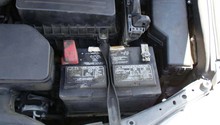
- Take one of the red (positive) jumper cable clamps and connect it to the dead battery positive terminal.
- Take the other red jumper cable clamp and connect it to the donor battery positive terminal.
- Take the black (negative) jumper cable clamp and connect it to the donor battery negative terminal.
- Take the other black jumper cable clamp and either connect it a non-painted metal portion of the dead vehicle, or to the negative battery terminal.
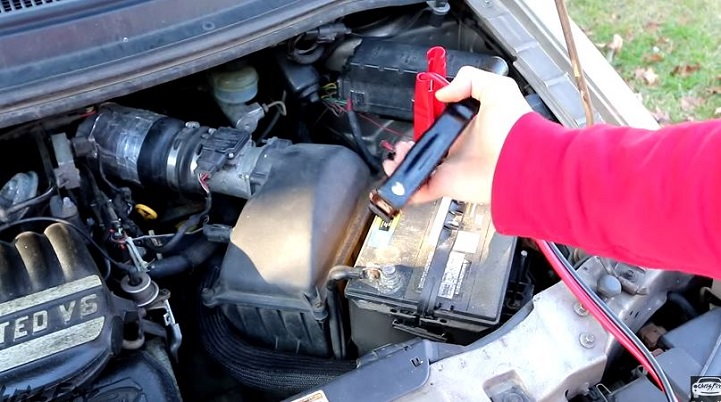
Step 5 – Start the donor vehicle
Once the jumper cables are connected, start the donor vehicle. Let it run a few minutes before attempting to start your stranded car.

Warning
Stand clear of both batteries when the car is first started. If either battery happens to explode, you don't want to be anywhere near the flying acid.
Step 6 – Start the dead battery
Once the donor vehicle has been running for a couple of minutes, start the dead battery. It should now start right up. If not, your battery is completely shot and will need to be replaced. Otherwise, let your car run for a couple of minutes before disconnecting the jumper cables.
Step 7 – Turn off both vehicles and remove the jumper cables
Turn off both vehicles and remove the jumper cables in the reverse order. Make sure to not let the ends of the alligator clips touch each other when they are still connected to the batteries. Once the cables are removed, start your car again. It should start right up. Let it idle for a few minutes before taking off.
Related Site and Video
- How to Jump Start a 2007-2011 Toyota Camry - Carcarekiosk.com
- How to Properly Jump Start a Car Battery - Youtube.com